I wasn't even looking for blog fodder today, but while reading a book review on the NPR website a link on the side of the page caught my eye. Just look what NPR is reporting today:
I kid you not. To quote a Google Chat buddy and work colleague, "your blog is coming true sooner than we all thought." Indeed. Readers, I won't protest if you start calling me prescient.
According to a new study by the Translational Genomics Research Institute (TGen), the meat you buy at the supermarket has a significant chance of being contaminated by bacteria, and a slightly lower but not insignificant chance of being contaminated by multiple drug-resistant bacteria.
How did the researchers discover this? Simple. They went out, bought some meat, and tested it, as this press report describes. Specifically, researchers at TGen collected 136 samples of beef, chicken, poultry and turkey (covering 80 brands) from 26 retail grocery stores in Los Angeles, Chicago, Fort Lauderdale, Flagstaff, and Washington, DC. (Side note: how did they pick these five cities? They seem kind of random...maybe they had friends there?) (Second side note: in case you were wondering about what specific cuts of meat, the (open access!) article published on this study in Clinical Infections Diseases specifies that the beef was ground, the chicken in the form of breasts and thighs, the pork both in chops and ground form, and the turkey ground and in cutlets).
Anywho, they bought this meat and then they did some fancy scientist stuff and looked for bacteria (specifically staphylococcus aureus). And oh, did they find it! (Third side note: I do NOT recommend Google-imaging "staphylococcus aureus." Cannot. Unsee.) (Fourth side note: Staph infections kill more people than AIDS in the US). (Fifth and final side note: the large portion of killer staph infections are picked up in hospitals, not from meat.)
Back to the point. As NPR reports, of the samples tested "47 percent had evidence of Staphylococcus aureus (S. aureus) contamination. More than half of the bacteria they found were resistant to at least three classes of antibiotics."
I actually read through the four-page source study in Clinical Infections Diseases and it gives the breakdown of S. aureus contamination by meat type. First comes turkey (77% of samples were contaminated), followed by pork (42%), chicken (41%), and beef (37%). NINETY-SIX PERCENT of the S. aureus bits discovered were "resistant to at least 1 antimicrobial," including most commonly tetracycline, ampicillin, penicillin, and erythromycin, but also quinupristin/dalfopristin, fluoroquinolones, oxacillin, daptomycin, and vancomycin.
Multi-drug resistant strains of S. aureus--defined as "intermediate or complete resistance to 3 or more antimicrobial classes"--were "common," and was most prevalent among turkey, followed by pork, beef, and chicken. In total, 52% of the S. aureus isolates they found were multi-drug resistant.
Because there were distinct strands of the bacteria on each different kind of meat, it suggests that food animals are the predominant source of contamination, not human handling after the fact. This is not particularly surprising. To quote the authors of the study, "Conventional concentrated animal feeding operations (CAFOs) provide all the necessary components for the emergence and proliferation of multidrug-resistant zoonotic pathogens."
Now, before you panic and stop eating meat, the authors concede that "the public health relevance" of their study is "unclear," and as NPR notes, "most Staph found in meat can be eliminated by cooking food thoroughly." Nevertheless, "it can still pose a risk to consumers if handled unsafely or if it cross-contaminates with other things in the kitchen." And we in America should all be a at least a little bit worried, because we eat a ton of meat. And our meat eats a ton of antibiotics, as this chart demonstrates (chart taken from here, data from the FDA):
More thoughts about the way we make meat, a topic I am sure I will come back to, can be found here and here. More about antibiotic resistance here.
Until the next dispatch, be sure to cook your meat just a little more than you think is necessary.
Friday, April 15, 2011
Thursday, April 14, 2011
And you thought traffic was simply annoying
Remember when I posted a study suggesting that breathing might kill you? Well, it turns out it might also (or alternately) give you brain damage. Breathing in traffic, that is.
A study recently published in the journal Environmental Health and reported on in Time and the Los Angeles Times has discovered that freeway air pollution can cause brain damage in mice.
(Ain't that just swell, says the girl living in the city of a million freeways.)
In the study in question, researchers at USC exposed mouse-brain cells in test tubes and live mice to air laced with nanoparticles akin to those resulting from "burning fossil fuels and bits of car parts and weathered pavements" (to quote Time). These nanoparticles are truly nano, perhaps one-thousandth the width of a human hair. You can't see them, and more jarringly, your car can't filter them out of the air you're breathing. After only 10 weeks and 150 hours, "Both the in vitro brain cells and the neurons in the live mice showed similar problems, including signs of inflammation associated with Alzheimer's disease and damage to cells associated with learning and memory" (quoting Time again).
One of the major concerns coming out of this research is for the development of children living and attending school near highways. For not only could young people's brain functioning be altered by the nanoparticles constantly found in the air they breathe, but freeway pollution may be in part responsible for autism, and lung development could be stunted by breathing pollution as well. And that's just what I found out by clicking on USC press releases. Imagine what researchers at other schools are discovering about the dangers of breathing!
What's to be done? To quote the team that looked at the mouse brains, "That's a huge unknown."
I suppose not living in Los Angeles, Phoenex or Bakersfield would be a good start. Also, stay away from China.
And if you live near a freeway, think about moving!
(Or I suppose you could look into these attractive partial solutions offered by Amazon.com.)
A study recently published in the journal Environmental Health and reported on in Time and the Los Angeles Times has discovered that freeway air pollution can cause brain damage in mice.
(Ain't that just swell, says the girl living in the city of a million freeways.)
In the study in question, researchers at USC exposed mouse-brain cells in test tubes and live mice to air laced with nanoparticles akin to those resulting from "burning fossil fuels and bits of car parts and weathered pavements" (to quote Time). These nanoparticles are truly nano, perhaps one-thousandth the width of a human hair. You can't see them, and more jarringly, your car can't filter them out of the air you're breathing. After only 10 weeks and 150 hours, "Both the in vitro brain cells and the neurons in the live mice showed similar problems, including signs of inflammation associated with Alzheimer's disease and damage to cells associated with learning and memory" (quoting Time again).
One of the major concerns coming out of this research is for the development of children living and attending school near highways. For not only could young people's brain functioning be altered by the nanoparticles constantly found in the air they breathe, but freeway pollution may be in part responsible for autism, and lung development could be stunted by breathing pollution as well. And that's just what I found out by clicking on USC press releases. Imagine what researchers at other schools are discovering about the dangers of breathing!
What's to be done? To quote the team that looked at the mouse brains, "That's a huge unknown."
I suppose not living in Los Angeles, Phoenex or Bakersfield would be a good start. Also, stay away from China.
And if you live near a freeway, think about moving!
(Or I suppose you could look into these attractive partial solutions offered by Amazon.com.)
Wednesday, April 13, 2011
We're all Gonna Die presents: The Top 10 Environmental Disasters of All Time, brought to you by TIME
Someone at Time Inc. apparently really likes making top ten lists. (Side note: how do I get that job?) Happily (by which I mean horrifically), one that I stumbled upon yesterday seems ideal fodder for this blog, so I shall re-post it here as filler while I work on my next book recommendation.
Without further ado, let's explore the TOP 10 ENVIRONMENTAL DISASTERS....as of May 2010.* (Okay, a little more ado...I do want to clarify, because Time does not, that these are the top 10 man-made disasters. So of course we should be extra terrified.)
*Full disclosure: I'm pretty sure Time magazine just picked ten (mostly) horrific disasters to talk about; there's certainly no guarantee that more horrible things haven't happened.
Without further ado, let's explore the TOP 10 ENVIRONMENTAL DISASTERS....as of May 2010.* (Okay, a little more ado...I do want to clarify, because Time does not, that these are the top 10 man-made disasters. So of course we should be extra terrified.)
- Chernobyl: 1986 explosion of a nuclear power plant in Ukraine "that sent massive amounts of radiation into the atmosphere, reportedly more than the fallout from Hiroshima and Nagasaki." (Side note: A recent episode of This American Life has some strikingly sad stories about the fallout from Chernobyl. (Pun intended?))
- Bhopal: 1984 accident at a Union Carbide pesticide plant in Bhopal, India that resulted in 45 tons of poisonous methyl isocyanate escaping from the facility, killing 15,000 and affecting more than half a million people.
- Kuwaiti Oil Fires: In 1991, Saddam Hussein sent men to blow up Kuwaiti oil wells, and approximately 600 were set ablaze. The resulting fires, "literally towering infernos," burned for seven months. Writes Time, "The Gulf was awash in poisonous smoke, soot and ash. Black rain fell. Lakes of oil were created."
- Love Canal: In the 1940's and 1950's, a company near Niagara Falls, NY buried 1,000 tons of toxic industrial waste under the town of Love Canal. Subsequently, a town was unwittingly built on top of the waste dump, and "over the years, the waste began to bubble up into backyards and cellars." By 1978, the problem was so bad that hundreds of families had to sell their homes to the government and evacuate the area.
- The Exxon Valdez: In 1989, the Exxon Valdez oil tanker ran aground Alaska's Prince William Sound, spilling 10.8 million gallons of oil into the water. This disaster taught schoolchildren (like me at the time) that dish detergent could clean oil off animals. Also, oil spills are bad.
- Tokaimura Nuclear Plant: 1999 nuclear accident in a facility northeast of Tokyo, Japan, which was the result of workers improperly mixing a uranium solution. I suspect that the newer Japanese nuclear explosion might top this one, but we may never know since Time has already made its "Top 10 environmental disasters" list.
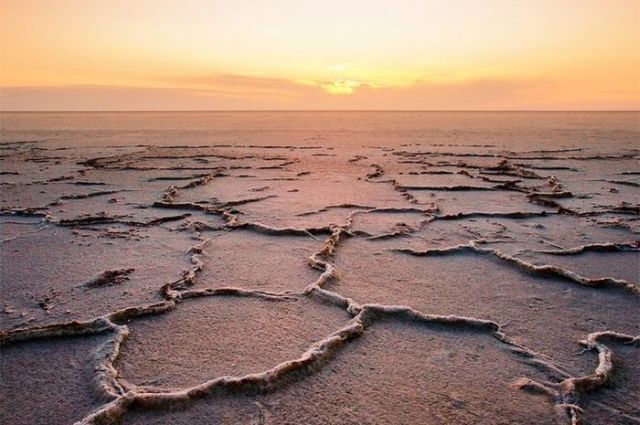
- The Aral Sea: In the 1960's, the Soviet Union ill-advisedly started piping water out of the Aral Sea. By 2010, the Aral had shrunk 90%, and, writes Time, "what was once a vibrant, fish-stocked lake is now a massive desert that produces salt and sandstorms that kill plant life and have negative effects on human and animal health for hundreds of miles around. Scores of large boats sit tilted in the sand — a tableau both sad and surreal." I hate to say it, but this kind of reminds me of what Easter Island did to itself...
- Seveso Dioxin Cloud: 1976 explosion at an Italian chemical plant that released a giant cloud of dioxin that settled on the town of Seveso. Writes Time, "First, animals began to die...One farmer saw his cat keel over, and when he went to pick up the body, the tail fell off. When authorities dug the cat up for examination two days later, said the farmer, all that was left was its skull." Today, there are giant underground tanks that "hold the remains of hundreds of slaughtered animals."
- Minamata Disease: This is the one that terrifies me the most, possibly because of the coverage of the disease in The Cove, and partly because I think we are all contaminated with Mercury these days. Minamata Disease is the result of "industrial poisoning of Minamata Bay by the Chisso Corp.....As a result of wastewater pollution by the plastic manufacturer, large amounts of mercury and other heavy metals found their way into the fish and shellfish that comprised a large part of the local diet. Thousands of residents have slowly suffered over the decades and died from the disease." Mercury is BAD NEWS, people. Bad. News.
- Three Mile Island: 1979 partial meltdown of a nuclear reactor near near Harrisburg, Pennsylvania. I think this one made Time's list only because it happened in America. To quote the listmaker, "The ironic thing is that while it has become known as one of America's worst nuclear accidents, nothing much really happened. No one died, and the facility itself is still going strong." Time, may I suggest you replace this with something more dire?
![]() |
| The Aral "Sea" |
Tuesday, April 12, 2011
Let's talk about antimicrobial resistance, baby, let's talk about you and me...let's talk about all the good things and the bad things that may be. But mostly the bad things.
Remember when people used to die left and right from curable diseases, simply because we hadn't discovered antibiotics yet?
Of course you don't...that was way back in the middle ages (or thereabouts--I was never much good at history). You know, back when people believed diseases were caused by an imbalance of humours in the body, and/or god sending punishment. Plus nobody really knew that lack of proper sanitation could cause death. So I guess there were other mitigating factors in the high death rate from theoretically curable diseases...but still, lack of antibiotics and other drugs didn't help the matter.
We in the developed world with our fancy medicine and cleanly hospitals like to feel smug because we no longer die from the same horrible diseases as they did in the middle ages, but we aren't actually as protected as we think. I'm sure you have all heard about the controversy about feeding antibiotics to animals, the overperscritpion of antibiotics, and the rise of antibiotic resistant bacteria? Well, that's today's fear-inspiring topic for "We're all gonna die."
Recently, a super-antibiotic-resistant bacteria was found in the water supply in New Delhi. This bacteria is called NDM-1, and not only was it found in the water people drink, not only does it have its own website, but it also has the potential to give its antibiotic resistance to other bacteria! As a reporter for the Guardian writes:
The bacterium was found to be indifferent to even our most powerful antibiotics. To make matters worse, the genes that gave it this superpower were found on a small ring of DNA that is easily traded between different species of bacteria.
New Delhi metallo-beta-lactamase (NDM-1) has since turned up in more than 16 countries across the world, including Britain. A study published in Lancet Infectious Diseases today shows the resistance factor has spread to 14 different species of bacteria, including pathogenic varieties responsible for dysentery and cholera. Most bacteria holding the NDM-1 plasmid are resistant to all but a couple of our most clumsy, brutal antibiotics. One strain is immune to all of them.
This news is quite alarming, and it (along with other similar concerns) has spurred worldwide alarms from the medical community. The World Health Organization made antimicrobial resistance the theme of World Health Day 2011, under the slogan (and I am not making this up, though I am bolding and italicizing it):
Antimicrobial resistance: no action today, no cure tomorrow.
A representative of the WHO posted a Q&A about the topic, and in response to the question "Is this the doomsday scenario of a world without antibiotics?" he answered:
Unfortunately yes, with these new multiresistant NDM1-containing strains and their potential for worldwide spread. Doctors will face a terrible dilemma when a pregnant woman develops a kidney infection that spills over into the bloodstream with a pan-resistant strain containing NDM1 and there are no treatment options. We are essentially back to an era with no antibiotics.
I don't think it's hasty if I say it is TIME TO PANIC!!
Diseases associated with antimicrobial resistance include but are certainly not limited to things like Staph (MRSA), Anthrax(!), Gonorrhea, and of course, Tuberculosis. (Side note: If you're interested in multi-drug resistant TB (and who wouldn't be), this is a really good book.)
A WHO pamphlet released in conjunction with World Health Day 2011 has some fun facts about antimicrobial resistance (AMR):
- About 440,000 new cases of multidrug-resistant tuberculosis (MDR-TB) emerge annually, causing at least 150,000 deaths. Extensively drug-resistant tuberculosis (XDR-TB) has been reported in 64 countries to date.
- Resistance to earlier generation antimalarial medicines such as chloroquine and sulfadoxine-pyrimethamine is widespread in most malaria-endemic countries. Falciparum malaria parasites resistant to artemisinins are emerging in South-East Asia; infections show delayed clearance after the start of treatment (indicating resistance).
- A high percentage of hospital-acquired infections are caused by highly resistant bacteria such as methicillin-resistant Staphylococcus aureus (MRSA) and vancomycin-resistant enterococci.
- Resistance is an emerging concern for treatment of HIV infection, following the rapid expansion in access to antiretroviral medicines in recent years; national surveys are underway to detect and monitor resistance.
- Ciprofloxacin is the only antibiotic currently recommended by WHO for the management of bloody diarrhoea due to Shigella organisms, now that widespread resistance has developed to other previously effective antibiotics. But rapidly increasing prevalence of resistance to ciprofloxacin is reducing the options for safe and efficacious treatment of shigellosis, particularly for children. New antibiotics suitable for oral use are badly needed.
- AMR has become a serious problem for treatment of gonorrhoea (caused by Neisseria gonorrhoeae), involving even “last-line” oral cephalosporins, and is increasing in prevalence worldwide. Untreatable gonococcal infections would result in increased rates of illness and death, thus reversing the gains made in the control of this sexually transmitted infection.
- New resistance mechanisms, such as the beta-lactamase NDM-1, have emerged among several gram-negative bacilli. This can render powerful antibiotics, which are often the last defence against multi-resistant strains of bacteria, ineffective.
Just in case you didn't read through all of that dense text, the fun facts indicate that we may no longer be able to cure malaria, staphylococcus infections, bloody diarrhea, gonorrhea, and NDM-1 infections.
As the WHO notes, complacency kills. I think I'll leave you with that.
Monday, April 11, 2011
Friday, April 8, 2011
Proof I'm probably wrong
This happened in 1990, and the world is still spinning:
I'm as surprised as you are. I would have thought this was a sure sign of the imminent destruction of mankind.
Thursday, April 7, 2011
Only eight months until 2012...
Call me a pessimist, but we might need to start preparing for the End Times like, now.* Just look at what has happened in the last day or so!
Another giant earthquake in Japan!
A pretty big earthquake in Mexico.
A less big earthquake in Arkansas.
Announcement of two Jersey Shore spin-off shows, featuring JWow/Snooki and DJ Pauly D.
Need I say any more?
On top of all this, I learned today that cats have been known to sleep with babies...on their faces...suffocating them. Evidently this is not news, however, as this New York Times article from 1909 attests:
Thank goodness I'm allergic to cats, is all I have to say about that (and we haven't even touched on toxoplasmosis!). Not that I have a baby, but still. If California gets hit by a giant earthquake, causing major societal collapse and disruption of the food supply, I'm going to recommend eating the cats first of all. We've got to save the babies!
Keep up with your earthquake sightings here. And learn more about cats suffocating people, such as drunken college students, here.
*By preparing for the end times I mostly mean buying a gun and investing in some water filtration products. Don't want to get too crazy, now.
Another giant earthquake in Japan!
A pretty big earthquake in Mexico.
A less big earthquake in Arkansas.
Announcement of two Jersey Shore spin-off shows, featuring JWow/Snooki and DJ Pauly D.
Need I say any more?
On top of all this, I learned today that cats have been known to sleep with babies...on their faces...suffocating them. Evidently this is not news, however, as this New York Times article from 1909 attests:
Thank goodness I'm allergic to cats, is all I have to say about that (and we haven't even touched on toxoplasmosis!). Not that I have a baby, but still. If California gets hit by a giant earthquake, causing major societal collapse and disruption of the food supply, I'm going to recommend eating the cats first of all. We've got to save the babies!
Keep up with your earthquake sightings here. And learn more about cats suffocating people, such as drunken college students, here.
*By preparing for the end times I mostly mean buying a gun and investing in some water filtration products. Don't want to get too crazy, now.
Wednesday, April 6, 2011
Now I have to wear sunscreen when I drive?
Apparently your car windows don't filter out cancer-causing deathly sun rays, says The New York Times:
This is reason #1,504 that I need to get out of Southern California. I can't escape the awful death rays!
****
Related: Below is a picture I drew during a boring meeting over the summer. It was so hot and so sunny that day, the memory still makes me shudder.
In a study published last year in The Journal of the American Academy of Dermatology, researchers at St. Louis University School of Medicine examined the records and histories of more than 1,000 patients referred to a local skin cancer clinic. They found that people who had spent the most time driving a car each week were more likely to develop skin cancers on the left sides of their bodies and faces — the side exposed to more sunlight while driving. In patients with malignant melanoma, the deadliest form of skin cancer, 74 percent of the tumors were found on the left sides, compared with 26 percent on the right.(Pubmed abstract here.)
This is reason #1,504 that I need to get out of Southern California. I can't escape the awful death rays!
****
Related: Below is a picture I drew during a boring meeting over the summer. It was so hot and so sunny that day, the memory still makes me shudder.
Tuesday, April 5, 2011
We're All Gonna Die: Recommended Reading
Because part of my fatalistic world outlook has resulted from some books I've read, I thought I'd start an intermittent feature called "We're All Gonna Die: Recommended Reading." I think if the world were going to end tomorrow, I might spend today reading...I love books that much.
Anywho, the first doomsday book I'm going to recommend to those of you who are in the market for such things is the one that got me started down the path that lead to this blog: Jared Diamond's Collapse.
It's been four or five years since I read this book, but I find myself thinking about it from time to time. While it doesn't quite live up to the "masterpiece" status of Guns, Germs, and Steel, Collapse does contain an interesting analysis of how environmental degradation contributes to societal downfall.The basic premise of the book is that civilizations and societies often collapse not because of a cataclysmic event (like the meteor impact that might have doomed the dinosaurs), but rather because they choose to maintain themselves socially at the risk of ecological devastation.
Malcom Gladwell wrote a very nice book review of Collapse in the New Yorker and described the phenomenon (as it played out on Easter Island) thusly:
...Look...at Easter Island. Once, it was home to a thriving culture that produced the enormous stone statues that continue to inspire awe. It was home to dozens of species of trees, which created and protected an ecosystem fertile enough to support as many as thirty thousand people. Today, it’s a barren and largely empty outcropping of volcanic rock. What happened? Did a rare plant virus wipe out the island’s forest cover? Not at all. The Easter Islanders chopped their trees down, one by one, until they were all gone. “I have often asked myself, ‘What did the Easter Islander who cut down the last palm tree say while he was doing it?’ ” Diamond writes, and that, of course, is what is so troubling about the conclusions of “Collapse.” Those trees were felled by rational actors—who must have suspected that the destruction of this resource would result in the destruction of their civilization. The lesson of “Collapse” is that societies, as often as not, aren’t murdered. They commit suicide: they slit their wrists and then, in the course of many decades, stand by passively and watch themselves bleed to death.In another section of the book, Diamond discusses the Norse settlement of Greenland, and how the Norse's stubbornness in insisting on replicating the European way of life--despite clear indications that Greenland could not support it ecologically--lead them to starve to death. The part that sticks with me about this is that the priests--who maintained high status until the end--were, Diamond says, "the last to starve."
Sometimes I think America is too complacent about what is happening to the world environmentally because we are going to be the last to starve.
Collapse also discusses more recent societal treatment of the environment, and its discussion of China, Australia, Rwanda, and Haiti are all fascinating. I highly recommend the book, although I must say the section covering the Greenland Norse gets a bit long and boring. Keep on going through it, as the rest of the book is worth it.
We're All Gonna Die gives four stars (of five) to Jared Diamond's Collapse. Read it before you are the last to starve!
Read more.
Don't like reading?
Read more.
Don't like reading?
Saturday, April 2, 2011
File this one under "America might implode from stupidity"
Evidently, Rutgers University has paid Toni Morrison--Nobel Prize winner Toni Morrison--$30,000 to speak at their graduation this year. Seems a reasonable sum for a Nobel Lauriate.
Ah, but!
In almost the same breath, Rutgers also paid Snooki, yes, that Snooki--Jersey Shore Snooki--to speak. How much did Snooki fetch? $2k more than Toni Morrison, that's how much.
The funniest part of this story is that somebody called Toni Morrison for comment on this issue, and her response was "I don't know her, and I don't care." Zing!
Of course, there are many caveats here. First and foremost, the university paid for Morrison, while the student association paid for Snooki. And evidently, Morrison cut her fees in half as a special favor for Rutgers.
Still, I think this is emblematic of a larger problem in America. Don't you?
*****
Now for my part in contributing to America's downfall through stupidity: Who do you think would win in a fight, Toni or Snooki? As far as I'm concerned, it's a toss-up.

Ah, but!
In almost the same breath, Rutgers also paid Snooki, yes, that Snooki--Jersey Shore Snooki--to speak. How much did Snooki fetch? $2k more than Toni Morrison, that's how much.
The funniest part of this story is that somebody called Toni Morrison for comment on this issue, and her response was "I don't know her, and I don't care." Zing!
Of course, there are many caveats here. First and foremost, the university paid for Morrison, while the student association paid for Snooki. And evidently, Morrison cut her fees in half as a special favor for Rutgers.
Still, I think this is emblematic of a larger problem in America. Don't you?
*****
Now for my part in contributing to America's downfall through stupidity: Who do you think would win in a fight, Toni or Snooki? As far as I'm concerned, it's a toss-up.

Friday, April 1, 2011
Stop feeding your children crap.
You might be giving your kid ADD just by feeding him or her.
A recent study published in the Lancet has demonstrated that a not insignificant proportion of ADHD cases might be induced by food. A summary of the article and associated press coverage can be found over at Civil Eats.
The part that scared me the most about the Civil Eats article was this:
A recent study published in the Lancet has demonstrated that a not insignificant proportion of ADHD cases might be induced by food. A summary of the article and associated press coverage can be found over at Civil Eats.
The part that scared me the most about the Civil Eats article was this:
There are a multitude of credible scientific studies to indicate that diet plays a large role in the development of ADHD. One study found that the depletion of zinc and copper in children was more prevalent in children with ADHD. Another study found that one particular dye acts as a “central excitatory agent able to induce hyperkinetic behavior.” And yet another study suggests that the combination of various common food additives appears to have a neurotoxic effect—pointing to the important fact that while low levels of individual food additives may be regarded as safe for human consumption, we must also consider the combined effects of the vast array of food additives that are now prevalent in our food supply.Nobody knows the cumulative effect of the "safe" crap that food manufacturers add to food! The cynic in me says they don't want to find out, either...it's not good for business.
This is why I shop at Whole Foods. It might be taking me to the poorhouse, but at least I can pronounce and understand the ingredients in the food I'm eating.
Plus, they have a kickass selection of gluten free food.
Sunday, March 27, 2011
Scratch Oregon off the list of places I'd like to live!
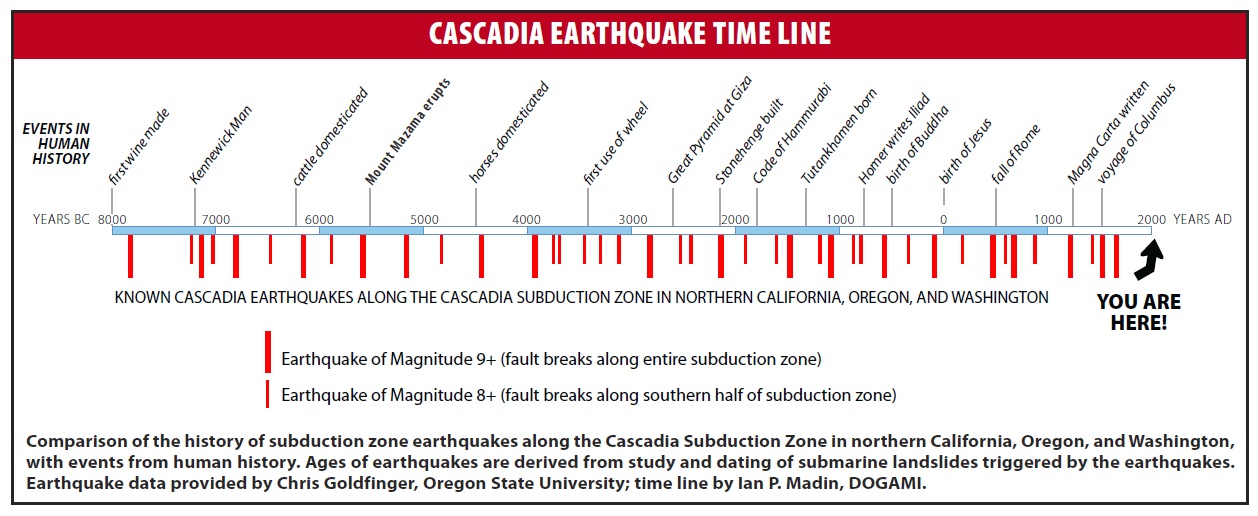
Apparently Oregon is 300+ years overdue for an earthquake that could send a Tsunami all the way to Japan. One expert called the fault line running through Oregon “9 months pregnant and overdue”(in geologic terms, that is). This time line proves it:

An informative pamphlet about Oregonian earthquakes can be found here. (That's where I stole the earthquake timeline.)
Man, and I've been worried about earthquakes living here in LA! I heard a thing on the radio today that said I should have an earthquake kit in my house and my car. Should i be worried that I don't have one in either place? All I have right now is a half-baked plan to grab my computer, external hard drive, camera and wallet and run the hell out of here at first sign of trouble.
Maybe I should get a gun. I'm sure in the apocalypse whoever has the most bullets is going to come out the winner.
Or, you know, I could put some jugs of water and cans of soup in my car.

An informative pamphlet about Oregonian earthquakes can be found here. (That's where I stole the earthquake timeline.)
Man, and I've been worried about earthquakes living here in LA! I heard a thing on the radio today that said I should have an earthquake kit in my house and my car. Should i be worried that I don't have one in either place? All I have right now is a half-baked plan to grab my computer, external hard drive, camera and wallet and run the hell out of here at first sign of trouble.
Maybe I should get a gun. I'm sure in the apocalypse whoever has the most bullets is going to come out the winner.
Or, you know, I could put some jugs of water and cans of soup in my car.
Friday, March 11, 2011
Signs of Armageddon?

In case you haven't heard, there was a giant earthquake in Japan.
I really hope I get out of LA before California gets its long overdue quake. I'm not sure my apartment could stand up to a major shift in the earth's crust. Though I do think I'm far enough away from the ocean that I wouldn't be flooded...I think. I hope. Maybe I should invest in a scuba suit just in case.
Thursday, March 10, 2011
Wednesday, March 9, 2011
First grocery carts, now BART seats
It's probably not safe to touch anything. Ever.
The thing that surprises me most about this New York Times article about the disgusting bacteria hiding in the seats on BART is that the BART police received only 245 complaints of urinating or defecating on BART last year. That's not even one complaint per day! Perhaps humanity is cleaner than I suspected.
Side note: BART police? Sounds like a cushy job. Pun intended! Yuk Yuk.
The thing that surprises me most about this New York Times article about the disgusting bacteria hiding in the seats on BART is that the BART police received only 245 complaints of urinating or defecating on BART last year. That's not even one complaint per day! Perhaps humanity is cleaner than I suspected.
Side note: BART police? Sounds like a cushy job. Pun intended! Yuk Yuk.
Monday, March 7, 2011
Saturday, March 5, 2011
The Sixth Mass Extinction is a really good name for a band, come to think of it
A study just published in Nature has pointed out that it's just about time for the earth's sixth mass extinction, and that this extinction might in fact be underway as we speak.
Time magazine, covering the story, suggests that within 300 years 75% of the species on the planet could be wiped out.
National Geographic thinks change is coming even faster:
I've done some Googling on the "sixth mass extinction," and all I can say is I wish I hadn't. Although I must admit it is somewhat gratifying that there is a group of scientists that share my "we're all gonna die" perspective. Take this cheery article abstract from the Asian Journal of Experimental Sciences, for example:
It doesn't feel very good to be called "just another stochastic event that is adversely affecting life on earth," does it?
I guess the moral of this story is that we should probably live it up because we're going extinct, possibly soon.
Time magazine, covering the story, suggests that within 300 years 75% of the species on the planet could be wiped out.
National Geographic thinks change is coming even faster:
By the year 2100, human activities such as pollution, land clearing, and overfishing may have driven more than half of the world's marine and land species to extinction.Dude, we eat those species!
I've done some Googling on the "sixth mass extinction," and all I can say is I wish I hadn't. Although I must admit it is somewhat gratifying that there is a group of scientists that share my "we're all gonna die" perspective. Take this cheery article abstract from the Asian Journal of Experimental Sciences, for example:
Mass extinctions probably account for the disappearance of less than 5% of all extinct species – 95% of species extinctions occur between mass extinctions. In short, extinction can occur at any time in Earth’s history. The concept of sustainable use of the planet assumes that humans can live on the planet indefinitely – or at least until the sun dies. However, human production of greenhouse gases is resulting in rapid climate change that threatens human society globally. In addition, greenhouse gas emissions are increasing markedly, and no agreement has been reached on specific goals for reducing emissions. Finally, coal is being used to replace diminishing supplies of petroleum, despite evidence that coal produces about twice as many greenhouse gas emissions per unit of energy produced than petroleum. Although alternative sources of energy (e.g., wind, solar, geothermal) are becoming increasingly popular, humankind’s primary source of energy is fossil fuels. Global climate change resulting from anthropogenic greenhouse gas emissions has already affected food production, water supplies, natural habitat, and human security. Climate change and other types of habitat destruction threaten the biospheric life support system upon which human survival depends. All these issues suggest that Homo sapiens may be just another stochastic event that is adversely affecting life on Earth.
It doesn't feel very good to be called "just another stochastic event that is adversely affecting life on earth," does it?
I guess the moral of this story is that we should probably live it up because we're going extinct, possibly soon.
Friday, March 4, 2011
Mmmm, estrogen.
Is your reusable plastic water bottle labeled BPA free? Doesn't mean it's free from chemicals that act like estrogen, as a recently published study has shown.
NPR Story here.
Until I hear that glass and metal are terrible too, I think I'll stick to these materials for food and water storage.
NPR Story here.
Until I hear that glass and metal are terrible too, I think I'll stick to these materials for food and water storage.
Thursday, March 3, 2011
Don't ever touch a grocery cart again
No, really.
A group of researchers at the University of Arizona recently released a study in which they analyzed the bacteria found on reusable shopping bags and grocery carts. As this article summarizes:
Gag.
*******
Sensible update, March 7:
If you wash your hands after grocery shopping you'll probably be fine.
A group of researchers at the University of Arizona recently released a study in which they analyzed the bacteria found on reusable shopping bags and grocery carts. As this article summarizes:
Researchers at the University of Arizona say shopping carts and reusable grocery bags are teeming with fecal matter and bacteria, often more than a typical bathroom.
...
72 percent of the carts [tested] had a positive marker for fecal bacteria and half had Escherichia coli (E. coli). He also found reusable shopping bags that are not washed regularly are swarming with bacteria.
Gag.
*******
Sensible update, March 7:
If you wash your hands after grocery shopping you'll probably be fine.
Subscribe to:
Posts (Atom)