Wednesday, October 12, 2011

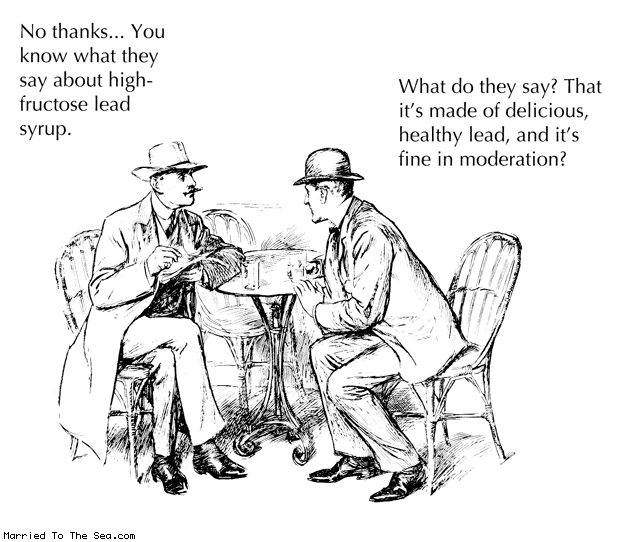
A little lead in moderation never hurt nobody!

Thanks to Jessie for today's funny:


In other news, this sounds like the most bad-ass corn maze ever.* It's just north of Boston...who wants to go?

*Also like the least bad-ass couple ever

Tuesday, October 11, 2011

Ever wonder which state boasts the highest likelihood of smashing one's car into a deer?

Wonder no more! According to State Farm the answer is West Virginia, where a driver has, on average, a 1 in 53 chance of colliding with a deer. This is followed by Iowa, where the chance is 1 in 77.

Wondering where one is least likely to hit a deer? To answer let me quote directly from this press release:
The state in which deer-vehicle collisions are least likely is...Hawaii (1 in 6,267). The odds of a Hawaiian driver colliding with a deer between now and 12 months from now are approximately equal to the odds that that driver is a practicing nudist.
I suppose if anyone would have figures relating to the odds of a driver being a practicing nudist, it would be an insurance company.

Monday, October 10, 2011

Friday fears, facts and funnies*

  1. Some people are concerned about robots taking over the world. Me, I'm more concerned that the monkeys will overwhelm us someday. (Disclaimer: I use the term "monkey" to mean any kind of primate; I shamefully do not know what distinguishes a monkey from other kinds of monkey-like beings. Orangutans are orange though, I know that.) Anyway, in July I ran across a fascinating article about which I haven't had a chance to properly blog but which I want to share before I forget. Listen to this, people: Monkeys are giving themselves pedicures! Combine that with those monkeys that have figured out to hunt with spears, and it's not too large a leap to think that the apes will be inventing gunpowder pretty soon, after which they will come for us.

  2. On my birthday (aside: I am now 30 and still not a "doctor," womp womp), it was revealed that my three-month-long campaign to improve my office's coffee situation was successful: We replaced our awful, ancient, dirty, foul-coffee-making coffeemaker with a Keurig! Everyone is thrilled (I'm the best assistant director ever!)...except for me, because I realized that (why did I not think of this before) I'm not really sure what is in those plastic K-cups. I mean, I know there's coffee in them, but what's in the packaging material is what I want to know. Hot water runs through that plastic cup and into my coffee cup and then I drink it...is that hot water loaded with leached chemicals? I bet you anything it's laced with BPA. (Gahhh. I said I wanted to know what's in there, but maybe I don't...)

  3. Presciently related: In June I wrote a little thing about BPA I never got around to finishing:
    BPA's been in the news yet again, with more alarming reports about our average levels of exposure to the chemical, as well as the consequences of such exposure. Civil Eats reports:
    According to a new study, exposure to the gender-bending chemical Bisphenol-A (BPA) is worse than previously estimated. The study, which appeared Monday [June 6] in Environmental Health Perspectives, is the first to recreate the chronic daily intake of BPA in humans, which leaches into our food–our primary channel for exposure–via its packaging. Researchers showed this by feeding a steady BPA-spiked diet to mice, whereas previous studies have only used a single exposure.
    One of the authors of the recently published article explains that BPA exposure via food packaging could be a significant problem, the depths of which are not yet understood:
    When BPA is taken through the food, the active form may remain in the body for a longer period of time than when it is provided through a single treatment, which does not reflect the continuous exposure that occurs in animal and human populations...We need to study this further to determine where the ingested BPA becomes concentrated and subsequently released back into the bloodstream to be distributed throughout the body.

    We know that the active form of BPA binds to our steroid receptors, meaning it can affect estrogen, thyroid and testosterone function. It might also cause genetic mutations. Thus, this chemical can hinder our ability to reproduce and possibly cause behavioral abnormalities that we are just beginning to understand.
    Grrrreat...now I'm concerned I'm getting a dose of behavioral abnormalities every morning with my (quite tasty) coffee. And I don't think this is an invalid concern, either.

  4. What if human beings aren't born with an "instinct" to believe in the supernatural? Is such illogic something we really want to inculcate our children with?

  5. Did you know there's a peanut shortage? Neither did I.

  6. Finally, two funny videos I've been sent recently that I've watched and re-watched all week. The first you've probably seen, the second I'd guess not:

    Tuna, Eggs, Doritos, Cheesecake, Tamale, See ya!

    Straight-up got mauled by a cougar!

  7. Today's Sunday, but tomorrow's still the weekend...Thank you Christopher Columbus! You are not my favorite dude, but any day on which I get paid for not going to work is definitely one I cherish.

*Wrote most of this on Friday, publishing it on Sunday, keeping the title for the alliteration.

Thursday, September 29, 2011

Halt your eating!

People, I have news: It might not be safe to eat anymore.

Surely by now you've heard of the listeria outbreak linked to cantaloupes grown at Jensen Farms in Colorado? It's one of the most deadly food-related outbreaks of all time (read: in the history of keeping such statistics), with somewhere from 13 to 16 people (depending on where you get your numbers) already dead and many more sickened. Although listeria is not commonly found in fruit (but rather animal products like meat and cheese), it is a rather scary pathogen because it doesn't slow its growth in low temperatures--meaning that if you put a tainted product in your refrigerator, the bacteria just keep reproducing. Listeria is also scary because once in your body, it is "aggressive in escaping the gastrointestinal tract" and can rapidly spread to places you really don't want it to go--like your spinal cord. (Typing that, I am reminded of this gem, which is completely unrelated except in its spinal reference and in its reference to deli meats, which are commonly contaminated with listeria.)

So far, the burden of death from listeria infections has primarily been borne by an elderly population, prompting a rather hilarious (to me) comment in the New York Times from some Seattle lawyer who "represents victims of food-borne illness" (what a happy job, btw):
This outbreak [of listeria linked to cantaloupes] might turn out to be especially deadly simply because cantaloupe is a food eaten by many older people.

"Sometimes in outbreaks, it’s the population that’s consuming the food that drives the numbers...In this instance, you’ve got a lot of people 60 and older who are consuming cantaloupe."
Read: Old people love cantaloupe. Really? I thought it was a favorite among people of all ages...or maybe I'm just old at heart, because I love the stuff.

Anywho, it's scary enough that cantaloupes are contaminated and that people are dying simply because they wanted to include some fresh fruit in their diet....but what's even more terrifying is what comes to light after some innocent googling for "listeria cantaloupes." For instance, this morning I learned almost by happenstance about the following pathogens lurking in foods that could be in your house right now (she says ominously):
Those are just a few of the stories I stumbled upon as I was "researching" the cantaloupe-listeria thing. I could probably find many more if I tried (the FDA keeps a running list!), but I think I'm plenty terrified already. I don't want to eat anything, ever again. Hence my blanket statement declaring it unsafe to eat.

(Brief aside: here's the best recall I've read about this morning: Pepperidge Farm has recalled a batch of their Baked Naturals Sesame Sticks because of the "possible presence of small, thin pieces of wire" in the sticks. Apparently "a small number of consumers have reported minor scrapes in and around the mouth." What...the...how does that even happen?)

Food pathogens are probably the number one reason why I'm so mistrustful of the industrial food system in this country (although now I'm worried about wires in my crackers as well!). Perhaps it is time to set in motion the plan that a friend and I concocted a few years ago for an organic farm off the grid in Montana. We haven't yet resolved our issues about whether or not we will eat the animals we tend on the farm (I say yes, she says no), but we could definitely get started with the veggies. No listeria for us!

Picasa's online photo editor is suuuper fun to play with.

Tuesday, September 27, 2011

Contagion = This blog times a million

Perhaps ill-advisedly, I saw Contagion over the weekend and omg I never want to touch anyone or anything ever again. I spent most of the movie curled in a fetal position, stressing out, and I walked out of the theater with a very strong desire to build a virus-proof underground shelter stocked with food, water, firearms, ammunition, and a BSL-4 grade biohazard suit. It's been a few days and I still have that urge, so perhaps I will spend my 30th birthday weekend (coming up too damn soon) preparing for the next global pandemic. Orrrrr....i'll spend it drinking wine. Only time will tell.


A professor at Columbia, who consulted on Contagion (and actually invented the film's (unnamed) disease (drawing from an real life bat-->pig-->human disease jumping example)) recently wrote an interesting op-ed piece about the film in the NYT that's worth a read. It describes the reality behind the film's fiction, which I think is important to consider, because it's far too easy to dismiss a fictional star-studded film as hyperbole when it's too hard or scary to face the real truths it brings to light.

***

Unrelated except in its apocalypse reference: Netflix would like to apologize for the inadvertent apocalypse.

Friday, September 23, 2011

Friday Fatigue

Man. It's hard to have a full time job, move across town/the country, write a dissertation, try to have a semblance of a social life,* AND keep up with this blog.

I've been bookmarking things to write about here, but let's be honest: I won't get around to most of it. So here's a list of things I've found interesting recently.

1. WATCH YOUR HEAD! I was informed yesterday that there's a satellite falling to earth that is going to clear orbit today, and that there's a 1 in 3200 chance it could hit a person (a statistic I have verified in an extremely detailed NASA PowerPoint). While this doesn't precisely translate into a 1 in 3200 chance that it could hit ME, I'm not taking any chances. I think I'll work from the subway today. They have wifi down there, don't they?

(Side note: In my brief research on this satellite-maybe-hitting-me business, I discovered that NASA has an entire office dedicated to studying things that fall from space and might hit me. They think of everything!)

2. The world's (allegedly) deadliest volcano might erupt soon. Not a good time to plan a trip to Indonesia, I guess.

3. Ever wonder how breakfast cereal is made? Wonder no more! (Also, eat cereal no more...ick.)

4. Speaking of icky industrial food, the first two parts of this piece have rather disturbed me. Wood pulp in our food, and tasteless OJ? Guess I'll be fresh-squeezing my juice from now on, and trying to avoid chemically-treated pulverized wood.

More on food-grade wood pulp here and here. (Worth reading about, in my opinion.)

5. More tax, more happy?

6. And finally, some fun. Researchers have analyzed male dance moves to discover what the ladies like the most. The results might surprise you, so I'll quote directly from the abstract [try here for the full article]: "Three movement measures were key predictors of dance quality; these were variability and amplitude of movements of the neck and trunk, and speed of movements of the right knee."

More specifically, the following aspects of dudes' dancing seems to account for most of the variability in ladies' ratings: neck internal/external rotation (head shaking), trunk abduction/adduction (sideways bending), and right knee internal/external rotation (twisting).

Not to be a hater, but there is literally no attractive dance I can imagine that involves shaking one's head while bending sideways and twisting the right knee rapidly. But what do I know.

Do you guys remember this guy? Check out that trunk abduction/adduction!

Happy Friday.


*I am blatantly failing at my goal of making no new friends until the dissertation is done. Shame on me.

Thursday, September 15, 2011

Seriously, this stuff is much more compelling than DARE ever was...

First I find out that cocaine can melt your face off, and now I learn that heavy use of marijuana can increase your chances of getting schizophrenia, especially if you use it during adolescence. What! Maybe drugs actually are bad for you!

A recent piece in Neuroscience and Biobehavioral Reviews has reviewed the scientific literature linking cannabis use and adult-onset psychosis/schizophrenia. Distressingly, the piece convincingly argues--using a number of different streams of research (particularly epidemiological (prospective and retrospective) and animal research)--that use of marijuana, at any point in life but particularly during adolescence, is linked (potentially causally?) to "schizophrenia outcomes." Indeed, pretty much all of the reviewed research on the topic that used human subjects, both from Western and non-Western populations, has shown that smoking the giggle weed is associated with a two- to three-fold increase in the risk of developing schizophrenia. The amount/extent of use is a factor as well--in one study of Swedish army conscripts, those who were heavy ganja users at the time of conscription were more than SIX TIMES as likely as non-users to receive a diagnosis of schizophrenia during the 27-year study period.

During adolescence, it is thought that cannabis use interferes with the development of neuronal networks, causing permanent brain changes that raise the likelihood of developing paranoia and schizophrenia. Studies in rats have shown that immature rats are more sensitive to the cognitive effects of cannabis, and that the "detrimental effects of acute cannabinoids on behavior are greater during puberty compared to adulthood." In an imaging study of human adolescents who had "long-term use of cannabis" (side note: how long could that term possibly be?), it was found that cannabis use "was associated with gyrification abnormalities in the cortex, suggesting that early cannabis use affected normal neurodevelopment." That does not sound good.

At this point I should probably pause to point out the obvious fact that smoking the jive stick won't necessarily give you schizophrenia--there are many other factors at play as well. To quote the article I read, "cannabis use is clearly not an essential or sufficient risk factor [for psychotic illness] as not all schizophrenic patients have used cannabis and the majority of cannabis users do not develop schizophrenia." Nevertheless, there is "a developmental link between cannabis and increased vulnerability to behavioral and cognitive impairments."

So here's my advice (kids, listen up): You may not think smoking the Mary J is a big deal now, but you'll be changing your tune when you start hearing God, the Devil and Zeus all talking to you at once, convincing you you can fly and that your coworker is poisoning your lunch. Just saying. You should probably wait to inhale until you're a bit older.*

***
In high school, my best friend and I were convinced that Vladimir and Estragon (protagonists in Becket's Waiting for Godot), were super stoned. Why else did they keep waiting/forgetting they were waiting for Godot?
***

In other crazy drug-related news, a bunch of people (in Texas and Seattle, according to this article, but California has this issue as well) have recently gotten botulism from black tar heroin. Yes, BOTULISM. The canned food disease. (Evidently this is old news...but it's new news to me, as everything I know about heroin I learned from watching Intervention, and none of the heroin addicts (that I've seen so far) have had to be hospitalized due to botulism.) Most of the heroin-related botulism cases come from wounds associated with injection sites.

(Aside: Remarkably, people have been known to get MULTIPLE CASES of "wound botulism" (as the medical literature calls it) at their heroin injection sites. You'd think once would be enough to learn your lesson, but apparently not!)

Another even more dire potential complication of black tar heroin use is necrotizing fasciitis (aka flesh-eating bacteria), one of the only diseases I can't even read about because it is so utterly terrifying. (Seriously. I didn't even look at the text of that Wikipedia article I just linked to; I don't want nightmares tonight!) There is no way to get rid of botulism from heroin (I have no idea if the flesh-eating bacteria is get-riddable, but let's just assume no), so it's probably best to stay away from the black tootsie roll. Aaaand...that's all I have to say about that.

This has been your PSA for the day. Stay away from the drugs, kiddos.

***

*This is by no means an endorsement of smoking weed or any other illegal substances.
Tuesday, August 30, 2011

Hurricanes and earthquakes and no dissertating at all...oh my!

So much doom and gloom lately in these here parts! First the east coast got rocked by an earthquake (aside: I love this article about the quake from the eminent Insurance Journal, perhaps for the article's title alone), and then Boston got hit by a hurricane (or almost a hurricane, anyway). I sadly did not feel the earthquake, and while I was properly terrified of Irene before the storm hit, I found the actual experience of the hurricane (or whatever it was) quite anticlimactic (as did many people, I suspect, as Irene's intensity forecast was just a bit off). We didn't even lose power! Though when I emerged from hiding at the end of the day on Sunday, I was treated to one heck of a mess on the street:


Check out this half-a-tree (rhymes with half-a-bee), perched precariously on the power lines (or telephone lines? How to tell the difference?):

Crazypants!

Though the storm caused less damage than expected, it was still pretty bad, and many experts believe there could be many more of these giant storms in the future, what with climate change and all. Next time one comes along I will make sure to not park under a tree.

That tiny branch almost hit my car!
I might also tune into the weather channel for the duration of the next storm. Sounds fun.

***

Even more doomful than the earthquake and the hurricane, however, is the fact that I have done almost no dissertating for the past two weeks. This is bad bad news, people. The damn thing is never going to get done!

Though I suppose things could be worse.

***

Mr. Diss is not pleased. He says, "GET TO WORK!"

Wednesday, August 17, 2011

No more swimming, I guess

First the ocean, now freshwater...is nowhere safe to swim?*

Always on the lookout for a nicely terrifying story for this blog, my good friend Tiffani just alerted me to this doozy:


Yup, you read right. Apparently, there's a amoeba that lives in "warm freshwater" (mostly lakes, rivers, and hot springs...but also improperly sanitized swimming pools) that can travel up your nose, into your brain, and cause your death within 1-12 days (according to the CDC, an outfit I tend to trust).

The unfriendly little organism that is capable of such feats is called Naegleria fowleri, and it's made national news this week because it has killed three people this summer--so far. That's quite a lot, considering that only 32 cases were reported to the CDC in the decade spanning 2000-2010. (Actually, maybe the number of 2011 deaths is not "a lot"...more like an average amount. But I'm still worrying.)

CNN describes in simple terms what the Naegleria fowleri does:
The amoebas enter the human body through the nose after an individual swims or dives into warm fresh water, like ponds, lakes, rivers and even hot springs. ...When an amoeba gets lodged into a person's nose, it starts looking for food. It ends up in the brain and starts eating neurons. The amoeba multiplies, and the body mounts a defense against the infection. This, combined with the rapidly increasing amoebas, cause the brain to swell, creating immense pressure. At some point, the brain stops working.
Um....YIKES.

What you are probably wondering at this point (because I sure was wondering!) is what the symptoms of an amoebal takeover of your brain are. I'll tell you. Well, I'll let the CDC tell you:
Initial symptoms...start 1 to 7 days after infection. The initial symptoms include headache, fever, nausea, vomiting, and stiff neck. Later symptoms include confusion, lack of attention to people and surroundings, loss of balance, seizures, and hallucinations. After the start of symptoms, the disease progresses rapidly and usually causes death within 1 to 12 days.
It's like you think you have meningitis, but nope! The news is much worse! Just when you thought it couldn't possibly be worse.

What's most terrifying about the menace of Naegleria fowleri is not necessarily that it exists (though this is frightening indeed), but that a) it is 95% lethal (only ONE person in the US has survived an infection), and b) infection incidence increases when weather gets hot for long periods of time, and um, Global Warming, anyone?

So there you have it: Swimming in warm freshwater can lead to your death via an amoebal brain swarm. This has been your scary public service message of the day. You're welcome!

Also look! A diagram!


*I should probably say "safe and pleasant," as I suppose chlorinated and saltwater pools are a fairly safe swimming option. But swimming pools are icky.

Tuesday, August 16, 2011

Damned if you do and damned if you don't.

Turns out avoiding the sun altogether is perhaps just as dangerous* as cultivating a deep dark tan. Indeed, while too much sun exposure can give you skin cancer, it seems that that too little sun exposure (whether achieved by using too much sunscreen or by staying indoors) can lead to rickets, a disease associated with Vitamin D deficiency (and pirates). AKA, a disease about which I have made a mental note to ask my doctor, specifically concerning whether a diagnosis test exists, and if so, whether it (or hypochondria) is covered by my insurance.

But I digress. Here's what I wanted to talk about: A recent piece in the Journal of Family Health Care (which I found out about here) has noted that there's been an unexpected worldwide increase in rickets cases in recent years. Such an increase is unexpected, given our modern-day learnin' and all, and in this case it's doubly unexpected because the increase has been found in landlubbers from all socioeconomic classes (and children especially). Why is this happening? One word: Sun. Or actually three words: Not enough sun. Yep, because sun exposure is an important source of Vitamin D, in avoiding the sun (or preventing your skin from absorbing Vitamin D-enhancing rays) you drastically** increase your chances of rickets. As the author of the rickets piece notes in his or her abstract (sadly, my institution does not subscribe to the publication so I couldn't read the full text; also I was too lazy to find out the gender of the author):
...the advice in recent years for children to wear a high factor sunscreen and remain covered up while playing outdoors [is] partly felt to be behind the reason for [Rickets'] re-emergence...A tendency for children to stay indoors and watch TV or play on computer games, rather than play outside when the sun is shining, is arguably also another contributing factor.
This isn't just idle speculation, I should point out. There's actually been a recent, highly publicized case of a British child getting rickets because her mother was too diligent with the sunscreen. !!!!

So there you have it: Sun = Cancer. No Sun = Rickets. Just the wrong amount of Sun and No Sun = Rickets AND cancer. Happy Tuesday.


*Where "dangerous" is loosely defined
**Where a "drastic increase" is defined as "an increase of some extent that is unknown to me and may be small"

Tuesday, August 2, 2011

This is the first thing that's made me want to get off Facebook...and the Internet.

What if someone could point a camera at you and instantly know your name, social security number, and penchant for Farmville? That'd be creepy, right? And invasive? I certainly think so.

But surely, you say, such a thing is the suff of science fiction. Bad news: IT'S NOT. It's the stuff of reality today.  It might be time to panic.

As I discovered in this story (and this one), researchers at Carnegie Mellon have recently combined "an off-the-shelf face recognizer, cloud computing and publicly available information from social network sites — to identify individuals online and offline in the physical world" BY THEIR FACE.  As this article explains, "Since these technologies are also accessible by end-users, the results foreshadow a future when we all may be recognizable on the street — not just by friends or government agencies using sophisticated devices, but by anyone with a smartphone and Internet connection."  All someone has to do is point a camera at your mug and take a picture.

Lest you think this is just an academic exercise, here's a brief description of what the Carnegie Mellon team did with their technology:
In one experiment, Acquisti's team identified individuals on a popular online dating site where members protect their privacy through pseudonyms. In a second experiment, they identified students walking on campus — based on their profile photos on Facebook. In a third experiment, the research team predicted personal interests and, in some cases, even the Social Security numbers of the students, beginning with only a photo of their faces. (Source)
More info here.

I am, to put it mildly, quite disturbed.  We are way closer to a bleak dystopian future than I ever suspected.


***

Fun fact: The Blogger spell checker doesn't recognize the word "dystopian."  It suggests I may have meant "dyspepsia," "Fallopian," "Dionysian" or "Bostonian."  I think I need to get a doom-themed add-on for this thing.

Friday, July 29, 2011

Two books I refrained from buying at Borders' going out of business sale

It probably wouldn't be very good for my mental health to read these...


Besides, they were only 10% off and that's a pretty lame discount.

Wednesday, July 27, 2011

Interesting Tidbit: Food Dyes

Here's a neat little article about food dyes that I came across a while back. It should probably be called "Why I shop at Whole Foods almost exclusively," or "Why I often wish I lived in Europe." I mean...why would anyone put DYE in peas? Or orange peels? What is this world coming to! (Oh.)

Tuesday, July 26, 2011

Oh, god! Why am I so tall!

This just in: Tall people get cancer at higher rates than short people. Apparently this is already known in the epidemiological world, but it's news to me (Shocking news! Time to panic news!).

A study just released in the Lancet looked into the impact of height on the development of several common cancers, and found a significant and positive association between height and cancer incidence that was consistent across genders and cultures. For a large sample of British women, they also found a "clear and highly significant trend of increasing cancer risk with increasing height" even after controlling for confounding factors like age, region, socioeconomic status, smoking, alcohol intake, body-mass index, strenuous exercise, age at menarche, parity, and age at first birth. Just look at this graph of adjusted relative risks (RRs) per 10 CM in height and 95% floated confidence intervals (FCI) for total incident cancer (among the British women), by height (in CM). Not that I have a full grasp on what is actually graphed here, but the trend is clear: more height, more cancer.  I've helpfully pointed out the relative risk (odds?) of cancer for my own height. It's at the top of the graph! Oh god!


The authors of this study offer several possible explanations as to why tall people get more cancer:
The similarity of the height-associated RR for different cancers and in different populations suggests that a basic common mechanism, possibly acting in early life, might be involved. Adult height reaches its maximum between the ages of 20 and 30 years. Variation in height relates to genetic and environmental influences acting mostly in the first 20 years, or so, of life; environmental factors, including childhood nutrition and infections, are believed to predominate. Hormone levels, especially of growth factors such as insulin-like growth factors (IGFs), both in childhood and in adult life, might be relevant. Circulating levels of IGFs in adulthood and childhood affect cancer risk; IGF-I levels in childhood and adolescence are strongly related to skeletal growth, and levels in adulthood, although less strongly, to adult height.

Another possibility is that height predicts cancer risk because taller people have more cells (including stem cells), and thus a greater opportunity for mutations leading to malignant transformation. Height might thus be related to cancer risk through increased cell turnover mediated by growth factors, or through increased cell numbers. The relation between height and cancer risk might underlie part of the difference in cancer incidence between populations, and changes in cancer incidence over time. Adult height in European populations has increased by about 1 cm per decade throughout the 20th century. The increase in adult height during the past century could thus have resulted in an increase in cancer incidence some 10–15% above that expected if population height had remained constant. This assumes, of course, that the effect of height is independent of changes in other risk factors.
I do not like this. Not one bit.  It's like I'm being punished for drinking all that milk and eating all those vegetables while I was growing up. Bah!

Friday, July 15, 2011

Perhaps this is why I can't remember anything these days. (It's not old age after all!)

Science just published an article entitled "Google Effects on Memory: Cognitive Consequences of Having Information at Our Fingertips." Apparently (according to this guy (or gal)) because the internet has given us the ability to look anything up, any time, the way we remember things is changing. Or, put another way, what we remember is changing. It seems we are less prone to remembering facts, and more prone to remembering where we can find facts. I'm not sure if this is good or bad, but I sure know that it describes my favored memory retrieval process! The "Google effect," as it is called, is why you probably don't want me on your trivia team. I can't remember facts worth shit, but I sure can remember where I read about relevant content. (Thanks, brain. That's so useful for making me look like a non-idiot.)

As always, I am likely overgeneralizing the results of just one study. Here's the experiments that have led me to my rash conclusion (described here, as I don't currently have access to the full article.  Similar descriptions here):

In one experiment:
A group of dozens more undergrad participants read 40 trivia statements and then typed them into a computer. Half the participants were told that the computer would save their entry, the others were told the entries would be deleted. Participants in the "saved" condition performed worse at a subsequent recall test of the statements, as if they'd relied on the computer as an external memory store. Half the participants in both conditions had been instructed explicitly to try to remember the statements, but this made no difference to their memory performance. "Participants were more impacted by the cue that information would or would not be available to them, regardless of whether they thought they would be tested on it," the researchers said.
In another experiment:
A group of participants read trivia statements and then typed them out, with a message telling them which folder the statement had been saved in. Ten minutes later they wrote out as many of the statements as they could, and then they attempted to recall which folder each statement, identified by a single prompt, had been saved to (e.g. "What folder was the statement about the ostrich saved in?"). The striking finding here is that participants were better at remembering the location of the statements than the statements themselves. What's more, they were more likely to remember the location of statements which they'd failed to recall. It's as if we've become adept at using computers to store knowledge for us, and we're better at remembering where information is stored than the information itself.
Here's what I want to know: What the eff are we going to do when the apocalypse happens, and we can no longer access the internet??

Related:

XKCD

Tuesday, July 5, 2011

Happy birthday America, happy first day of work to me

Woke up a bit early for my first day of gainful employment since 2006, and I've got some time to kill. What do I decide to do? Find out about work- and firework-related death risks, of course! In honor of America's independence day, and my transition to the real world, I offer you these six ways to die:

1. Fireworks bunker explosion
2. Fireworks explosion during truck unloading
3. Falling off a cliff trying to avoid fireworks explosion

4. Sitting too damn long at a computer
5. Getting "displaced" (laid off)
6. Being unemployed

Now, off to blow dry my hair and get to work!  Well, first Dunkin Donuts, then work.

A classic.

Wednesday, June 29, 2011

Home for a week = Critical thinking faculties are on vacation

Some random stuff:

I secretly think that our children are not going to grow up in a world that is better than the one we grew up in.  Neither does Newsweek, I infer, as they recently published this article: Today's youngest Americans are likely to be worse [economically] off than their parents.

Meanwhile, while we're becoming poorer and poorer, we're also possibly harboring eyelash lice.  EYELASH. LICE. Let that sink in.


But on the upside, rising gas prices might make us skinnier.

Gratuitous picture of my nephew, with whom I spent the whole day.

Saturday, June 25, 2011

Dare to keep kids off drugs?

...Or dare them to do drugs? Let's just tell them about the flesh-eating levamisole that cocaine has allegedly been laced with, then see how bad they want to try it.

According to this article, "69 percent of cocaine shipments seized entering the United States contain levamisole, a veterinary drug linked to serious weakening of the immune system in humans." Says ABC, "the drug, used to deworm cattle, pigs and sheep, can rot the skin off noses, ears and cheeks."  Check out that picture I took from the ABC website. Ew!

This isn't just a sensational news story, either.  Even justice.gov warns of the dangers of laced cocaine--as of 2009, they report, 71% of tested wholesale cocaine samples contained levamisole.  And it's not just cocaine; New York State (from which I am proud to be from!) says that Heroin has also been laced with levamisole.

YUM.  And who said DARE doesn't work!

Friday, June 24, 2011

We made it!

3300 miles, untold amount of carbon emissions. Sorry, environment...I'll try not to do it again.

The final route, give or take.  Ithaca to Boston yet to be driven.

Petrified Forest National Park was wiiiindy!